Mostrando entradas con la etiqueta Grammar. Mostrar todas las entradas

jueves, 29 de diciembre de 2016

Verbs

Here I present four activities to work on topics related with verbs:

VERBS

First of all, we introduce the verbs activity to develop the children’s knowledge of verbs.

We are going to name verbs like “doing” word. Look at a picture showing lots of things happening. Make a list of verbs for the actions in the picture with the children (in infinitive).


Help children name the verbs for the bees’ actions in the first pictures. The children complete the infinitives by writing the verb roots. Then, read the next three verbs with the class and draw a bee making these actions. Finally, the children think of two verbs themselves, complete the infinitives and draw a bee doing each of these actions.


CONJUGATING VERBS 
Conjugating verbs activity has the same aim: develop the children’s knowledge of verbs.

Revise pronouns and their action with children. Now choose a verb and tell the class that they are going to join it to the pronouns. This is conjugating a verb.

The children choose a verb and write it on the line provided at the top. Then, they write their verb besides each pronoun. Remind children that for “he”, “she” and “it”, an “s” must be added to the verb root. The children draw a picture to show the person or people doing the action for their verb.


PAST TENSE
Past tense activity tries to develop the children’s knowledge of the past tense.

Explain that verbs often change to show when the action takes place. So far the verbs taught have all been in the present tense, which means they describe actions taking place now. If, however, the verb describes an action which has already taken place, it should be in the past tense.


In the activity, children write the verbs in the past tense. Then they decide if the sentences are in the present or past tenses. 


DOUBLING RULE
Doubling rule develops the children’s ability to recognise the short vowels in words, so that they learn when to apply the doubling rule before adding “-ed”.

Tell the children that endings which are added to words are called suffixes. If a word has a short vowel sound, it is important to be careful when adding a suffix that starts with a vowel, such as “-ed”. This is because the “e” behaves like a magic “e”, and changes the vowel sound in the word.

In this activity children have to write the verb roots in the past tense, remembering to apply the doubling rule. 


VERB ACTIVITIES NOTEBOOK: click here!

Pronouns

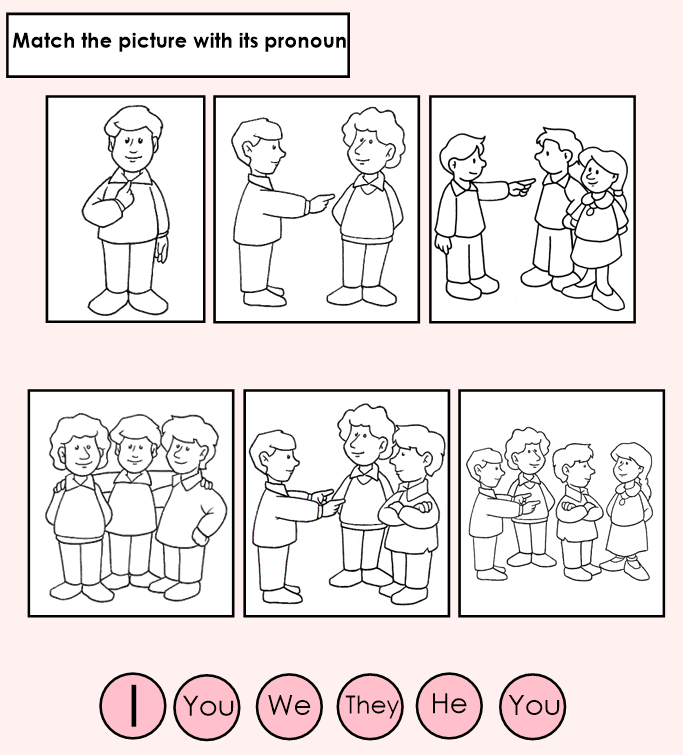
Pronouns activity tries to develop the children’s knowledge of personal pronouns.


Explain that to avoid continually repeating the same nouns, we use other, short words to take their place. These short words are calle pronouns. Pronouns take the place of nouns. Tell the children the personal pronouns. There is an action for each one:
  • I - point to self
  • You - point to someone else
  • He - point to a boy
  • She - point to a girl
  • It - point to the floor
  • We - point in a circle to include self and others
  • You - point to two other people
  • They - point to the next-door class

Children read the pronouns and draw pictures for them. For “I”, the children draw themselves. If the pronoun is plural they must draw more than one person.


PRONOUNS NOTEBOOK: click here!

Plurals

Plurals activity develops the children’s understanding of singular and plural and their knowledge that the simplest way to make the plural of a word is to add “s”.

Explain that nouns usually change when they describe more than one. The name for nouns which describe more than one is plural. The simplest way of making a plural is by adding an “s” to the end of the noun. Call out examples of singular nouns and ask the children to give plurals for them.
The children read each noun and decide whether it is singular or plural. They draw a picture for each, remembering that for plural nouns they must draw more than one item. Then they look at the pictures in the boxes underneath. They write the noun for each picture, remembering that if it shows more than one item, they must add an “s” to make the plural.

PLURALS NOTEBOOK: click here!

a - an

“A” or “AN” activity develops the children’s knowledge of when to use “an” instead of “a”.


Teacher stars explaining that usually if a noun starts with a vowel sound we use “an”, and if it starts with a consonant we use “a”. Then, s/he asks to children what each picture shows. The children can either just write “a” or “an” underneath each picture, or they can write the noun for the picture as well.

“A” or “AN” ACTIVITY NOTEBOOK: click here!

Propper nouns

Proper nouns activity tries to develop the children’s understanding that there are different types of words, and that each type has a special name.


Teacher explains to children that proper nouns are special names that are given to people, places or things. The children’s names are proper nouns. They have a capital letter to show how important they are. Other names are special too and they also need a capital letter, e.g. the name of the school, road, town, country...

In this case, students have to draw a picture of them in the first frame and write their name underneath, remembering to use a capital letter. Then, they write the name of their teacher under the second frame, and draw a picture in it. Then, they write the school address on the picture of the envelope. 


PROPER NOUNS NOTEBOOK: click here!

Sentences

Sentences activity tries to develop the children's understanding of sentences too.

Explain to the children that having a capital letter at the beginning of a line of writing, and a full stop at the end, does not make a sentence. The words in between must make sense too.


Here I present an activity in which students have to read each line of text and decide whether it is a proper sentence. If they think it is correct, thy copy the sentence underneath. If not they write the sentence correctly underneath. 


SENTENCES NOTEBOOK: click here!

Sentence sticking

The aim of Sentence sticking is to develop the children's understanding of sentences.

First of all, teacher has to explain that sentences help to organise words and to make meaning clear. Then s/he read a passage aloud, ignoring all the punctuation. Ask the children what is wrong and how they know where a sentence begins and ends.
In the activity, the students have to unscramble the words to make a sentence. Remind them to look for the capital letter to go at the beginning, and the full stop to go at the end.


SENTENCE STICKING NOTEBOOK: click here!

Rainbow Capitals

Rainbow Capitals tries that children develop their ability to recognise and write capital letters and also develop their knowledge of the alphabet.

In this activity children have to write inside the outlined letter, using a coloured pencil. Then, they have another go, writing the letters with a different coloured pencil. Their lines will cross over each other inside the outlines, but this does not matter. The children keep writing the letters, using a different coloured pencil each time, until each letter is filled with its own "rainbow"
An extension acitivity could be that children put letters into alphabetical order using tables, puzzles...

RAINBOW CAPITALS NOTEBOOK: click here!